
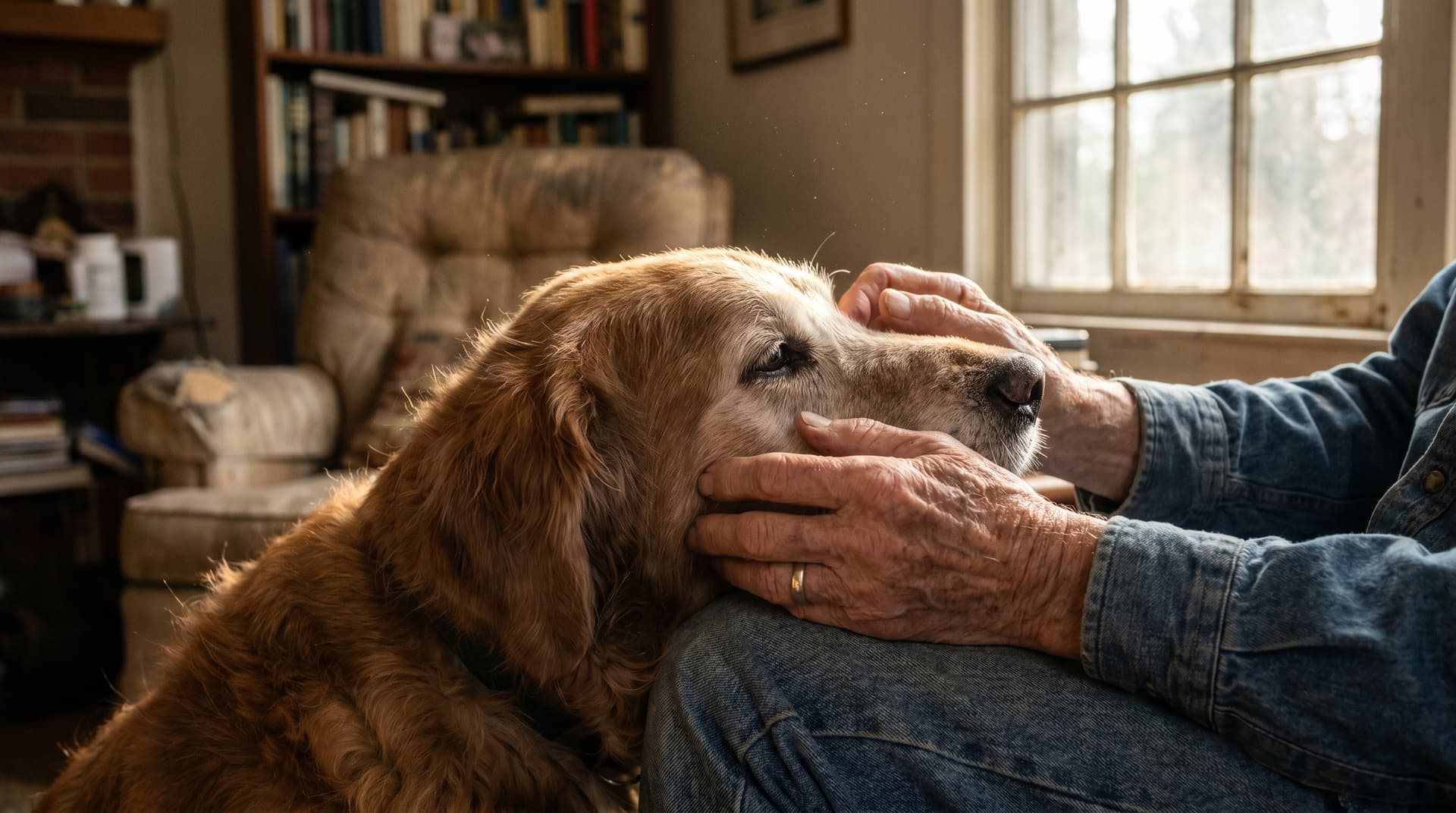
Dogs have long been described as man's best friend. A study published in The Journals of Gerontology suggests the bond runs deeper than loyalty — at the biological level, dogs and humans appear to age by much the same rules.
The Dog Aging Project finding
Researchers from the Dog Aging Project, a long-running nationwide study of pet dogs living with owners across the United States, analyzed blood samples taken from enrolled dogs and examined patterns of metabolites — small chemical compounds produced during normal bodily processes. Their question: are the same metabolic signatures that predict earlier or later death in humans also present in dogs?
The answer was yes, consistently so.
"The molecules that are risky for dogs or protective against a sooner death are very similar to those in people, showing that we share important features of aging biology, which is really interesting and rewarding," said Dr. Kate Creevy, chief veterinary officer for the Dog Aging Project and a professor in the Texas A&M College of Veterinary Medicine and Biomedical Sciences. "Our findings also highlight the value of pet dogs as a model for studying long-term health and lifespan."
Why the consistency matters
The team did not simply compare their dog data to one human dataset. They cross-referenced it against five large, published human mortality studies that used similar metabolite-based approaches. In each case, the aging and mortality signals aligned. That consistency across multiple independent human studies is what gives the finding its weight.
The paper — authored by Benjamin R. Harrison and colleagues — was published as "Dogs and humans share biomarkers of mortality" in The Journals of Gerontology, Series A.
An earlier chapter: the epigenetic clock
This finding builds on a body of research that has accumulated over several years. Earlier work pioneered "epigenetic clocks" for dogs — measuring aging at the level of DNA, where methyl groups attach to genes and influence their activity in ways that change predictably over time — and found that these molecular aging patterns are broadly shared between dogs and humans despite our very different lifespans.
That research established that the fundamental machinery of biological aging is largely conserved across mammals, laying the groundwork for the metabolite findings reported now.
The practical upshot: dogs as aging models
Dogs live roughly 12 to 13 years on average. That shorter lifespan, combined with the biological similarities now documented across multiple studies, makes them exceptionally useful models for aging research. Interventions that slow epigenetic aging in dogs could reasonably be expected to translate to humans — and vice versa — in ways that would take decades to test in people alone.
The Dog Aging Project was designed precisely to exploit this. By enrolling thousands of dogs and collecting detailed health data and biological samples over their lifetimes, the project creates a window into aging that would take far longer and cost far more to replicate in human cohorts.
What it means for your dog
For pet owners, the research carries an implication that is both humbling and oddly comforting: the gray muzzle that appears on your dog in middle age, the slowing pace, the shifting biomarkers — these are not merely animal processes. They are a version of what is happening inside every aging human as well. The science of keeping dogs healthy longer may, in time, have something to say about keeping people healthy longer too.
Sources: Texas A&M — Dogs and humans are more alike than we thought · The Journals of Gerontology — Harrison et al. · Dog Aging Project